Nov. 11, 2026
When I examine which parts of a sanitary pad are biodegradable, I do not treat the product as one uniform material. A sanitary pad contains several layers, and each layer may break down differently depending on whether it uses cotton, cellulose, bamboo fiber, polyethylene, polypropylene, superabsorbent polymer, adhesive, or paper. The most biodegradable components are usually plant-based fibers and cellulose, while plastic films, synthetic absorbent polymers, and many adhesives may persist for much longer.
!
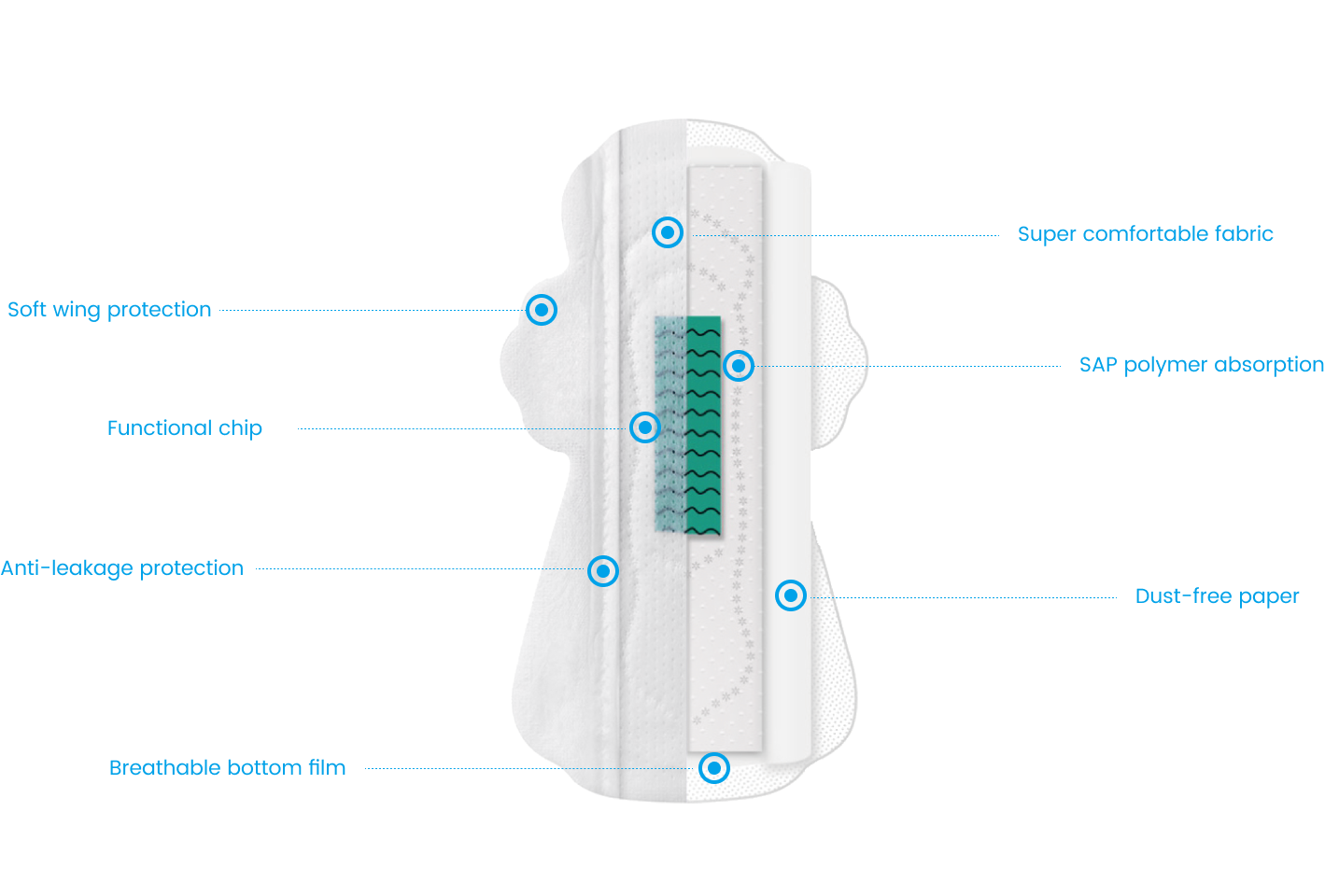
Cotton, bamboo, cellulose, wood pulp, and other plant-fiber portions may biodegrade, while conventional plastic films, synthetic superabsorbent polymers, and many adhesives generally do not. I assess biodegradability layer by layer because a pad can contain both biodegradable and persistent materials. The final result depends on the material composition, product construction, certification, and disposal environment.
| Pad component | Common materials | Typical biodegradability status | What buyers should check |
|---|---|---|---|
| Top sheet | Cotton, bamboo fiber, polypropylene, polyethylene | Biodegradable or conditional | Fiber content and surface treatment |
| Acquisition layer | Cellulose, rayon, polypropylene, polyester | Conditional | Whether synthetic fibers are included |
| Absorbent core | Wood pulp, cellulose, cotton, SAP | Mixed | Pulp-to-SAP ratio and absorbent polymer type |
| Backsheet | Polyethylene, polypropylene, plant-based film | Usually non-biodegradable or conditional | Film composition and certification |
| Adhesive | Synthetic hot-melt adhesive, bio-based adhesive | Usually persistent or conditional | Adhesive chemistry and testing |
| Wings | Nonwoven fabric, plastic film, adhesive | Mixed | Fabric, film, and adhesive layers |
| Release paper | Silicone-coated paper | Paper may biodegrade; coating may persist | Coating and disposal instructions |
| Individual wrapper | Plastic film, paper, compostable film | Mixed | Packaging material and certification |
| Outer packaging | Paperboard, plastic, bio-based film | Mixed | Recycling or composting label |
The top sheet is the layer that contacts the skin. In some Biodegradable Sanitary Pads, it may use organic cotton, bamboo fiber, viscose made from cellulose, or another plant-derived nonwoven material. These materials can biodegrade more readily than petroleum-based polypropylene or polyethylene, but the finished top sheet may still include synthetic binders, dyes, finishes, or reinforcement fibers.
Cotton is a natural fiber that microorganisms can break down under suitable moisture, oxygen, and temperature conditions. Bamboo fiber requires closer examination because “bamboo” may describe the original plant source, while the finished fiber may be regenerated cellulose or blended with synthetic fibers. I therefore look for a complete fiber declaration rather than relying on the word “bamboo” alone.
The acquisition layer sits below the top sheet and helps distribute menstrual fluid across the absorbent core. It may contain cellulose, rayon, polypropylene, polyester, or a blend of several fibers. A cellulose-based acquisition layer is more likely to biodegrade than one made mainly from synthetic nonwoven fibers.
This layer illustrates why a pad cannot be judged by its surface material alone. A product may advertise an organic cotton top sheet while using a synthetic acquisition layer underneath. For a more accurate assessment, I check whether the manufacturer identifies the materials used in each internal layer.
The absorbent core usually contains wood pulp, cellulose fibers, cotton, superabsorbent polymer, or a combination of these materials. Wood-pulp absorbent cores are plant-based and may biodegrade, but many conventional pads add superabsorbent polymer, commonly called SAP, to hold larger quantities of liquid in a thin structure.
Cellulose and wood pulp can decompose through microbial activity when the surrounding environment provides adequate moisture, oxygen, and biological activity. SAP is different because it is a synthetic polymer designed to remain stable while absorbing liquid. A core containing both pulp and SAP should therefore be described as partly biodegradable, not automatically fully biodegradable.
The absorbent core is often the hardest component to replace because it must balance liquid uptake, retention, thinness, odor control, and resistance to compression. Removing synthetic SAP may require a thicker pad, more cellulose, different channel designs, or a change in the product’s intended absorbency level.
The backsheet forms the leak barrier on the underside of the pad. Conventional backsheets commonly use polyethylene or polypropylene film because these materials resist liquid penetration and maintain flexibility during movement. These plastics generally do not biodegrade within ordinary household soil or landfill conditions.
Some products use plant-based or bio-based films, but bio-based does not always mean biodegradable. A film may be manufactured from renewable raw materials while still requiring industrial composting or remaining persistent after disposal. I look for the exact film material, applicable certification, and disposal route before treating the backsheet as biodegradable.
Adhesives hold the layers together and help attach the pad to underwear. They may also secure the wings, release paper, wrapper, and absorbent channels. Many sanitary pads use synthetic hot-melt adhesives, which are not normally considered biodegradable in the same way as cotton or cellulose.
Bio-based adhesive content may reduce dependence on fossil-based ingredients, but it does not automatically prove biodegradation. Adhesive formulations can include resins, tackifiers, stabilizers, and other components that behave differently after disposal. A reliable product claim should identify whether biodegradability applies to the adhesive itself or only to the main fiber layers.
Wings often combine nonwoven fabric, plastic film, and adhesive. The fabric portion may contain cellulose, cotton, polypropylene, or polyester, while the underside may include a leak-resistant film. Even when the wing fabric is biodegradable, its adhesive strip and release paper may not be.
For this reason, I treat wings as a mixed component unless the manufacturer provides a material breakdown. A pad with biodegradable top and core materials may still contain persistent wing components that affect the environmental profile of the complete product.
Release paper covers the adhesive before use. The paper base may biodegrade, but it is often coated with silicone or another release treatment to prevent the adhesive from sticking. The coating may reduce the rate at which the paper breaks down or require a specific industrial processing environment.
Release paper is small compared with the main pad, but it remains part of the total disposal stream. Buyers should check whether it belongs in paper recycling, general waste, or a composting system. Used release paper should not be flushed.
Individual wrappers and outer packaging can be made from plastic film, paper, compostable film, or a combination of materials. A paper wrapper may biodegrade more readily than a polyethylene wrapper, but inks, coatings, laminates, and adhesive closures can affect the final disposal route.
Packaging claims should be read separately from pad claims. A compostable wrapper does not make the used pad compostable, and recyclable outer packaging does not mean the inner menstrual product can enter a recycling bin.
The most common biodegradable sanitary pad materials are cotton, cellulose, wood pulp, bamboo-derived fiber, and other plant-based fibers. These materials provide a route for microbial decomposition, but the speed and completeness of breakdown depend on temperature, moisture, oxygen, microbial activity, and the presence of synthetic additives.
Cotton is relatively easy to identify because it is a natural fiber, although cotton pads may still include plastic backsheet films and synthetic adhesives. Cellulose and wood pulp are also widely used because they absorb liquid and can be processed into fluff or nonwoven structures. Bamboo-derived materials require more detailed labeling because the manufacturing process can change the material’s final properties and disposal behavior.
A sanitary pad marketed as biodegradable may still contain a small percentage of non-biodegradable materials. The relevant question is not only whether one component can break down, but whether the manufacturer defines the claim for the entire product, specific layers, or only the packaging.
Biodegradable means that microorganisms can break a material down into simpler substances over time. The term does not specify an exact decomposition period, a required temperature, or whether the product leaves residues. It also does not mean that the product will break down quickly in a landfill or ordinary garden soil.
Compostable is a narrower claim. It generally refers to material that can break down under defined composting conditions and produce compost-compatible residues within the requirements of a recognized standard or certification system. Some compostable products require industrial composting facilities with controlled heat, moisture, airflow, and processing time.
I do not assume that a biodegradable pad belongs in a home compost bin. Used menstrual products contain biological material and may require controlled waste treatment even when their fiber layers are plant-based. Unless the package provides specific composting instructions and certification, the used pad should normally be wrapped and placed in general waste according to local rules.
A biodegradable pad works by replacing selected petroleum-based components with fibers or films that microorganisms can process. Cotton or cellulose may form the top sheet and absorbent core, while a plant-based or modified barrier film may replace part of the conventional backsheet. The product must still maintain liquid distribution, absorbency, leak resistance, attachment, and skin comfort.
The main technical challenge is balancing biodegradability with practical menstrual protection. A cellulose-heavy core may require additional material to reach the same liquid capacity as a core containing SAP. A biodegradable backsheet may need careful construction to resist leakage without losing flexibility, and a bio-based adhesive must hold the pad together while remaining compatible with skin-contact materials.
Bainuo presents itself as a sanitary-product manufacturer offering biodegradable, organic cotton, and bamboo-fiber sanitary pad lines, alongside OEM and ODM services. Its published company information states that Guangdong Bainuo Sanitary Product Co., Ltd. was established in 2006 and operates R&D, production, laboratory, and packaging capabilities for disposable sanitary products. For a private-label buyer, these capabilities make layer specifications, testing documents, and packaging claims important questions to raise before approving a product.
I use the following label-reading checklist before accepting a biodegradable claim:
A vague phrase such as “eco-friendly” does not provide enough information to classify the product. I prefer a layer-by-layer declaration that identifies the material, the scope of the biodegradability claim, the test conditions, and the intended disposal route.
In a landfill, biodegradation may be limited because waste is compressed and oxygen availability is low. Some organic fibers may break down slowly, but the presence of plastic films, SAP, adhesives, coatings, and mixed materials prevents the entire product from behaving like a simple cellulose item.
In soil, plant-based fibers may gradually decompose when moisture and microorganisms are present. However, burying used sanitary pads is not a recommended disposal method because the product may contain bodily fluids, persistent components, and materials that are not suitable for uncontrolled release.
Industrial composting can provide controlled heat, moisture, airflow, and microbial activity, but acceptance depends on the facility. Many composting programs reject used menstrual products even when the wrapper or selected pad layers carry compostable claims. Incineration can reduce waste volume, but it is a waste-treatment method rather than proof that a product is biodegradable.
Sanitary pads should not automatically be flushed. Their absorbent core, backing film, wings, and wrapper can swell or remain intact, increasing the risk of plumbing blockages and wastewater problems. I follow the package instructions and local waste rules instead of treating biodegradability as permission to flush.
No. Conventional sanitary pads commonly contain a mixture of cellulose, plastics, synthetic fibers, superabsorbent polymers, adhesives, and coatings. Some portions may biodegrade, but the finished product may persist because its plastic and polymer components do not break down under the same conditions as cotton or wood pulp.
Even products labeled biodegradable may not be biodegradable in every component. The strongest interpretation comes from a complete product claim supported by material disclosure and relevant testing, rather than from one natural-fiber feature.
For sensitive skin, I would first evaluate fragrance, dyes, surface fiber, moisture management, and adhesive exposure. Biodegradability can be a useful material consideration, but it does not by itself establish skin compatibility or menstrual protection.
For buyers comparing products, I would place the following factors in order: complete material disclosure, absorbency suitability, leak-barrier construction, skin-contact materials, certification scope, disposal instructions, and packaging composition. A pad that replaces only the top sheet may offer a different environmental profile from one that replaces the core, backsheet, adhesive, wrapper, and release paper.
For manufacturers and private-label buyers, the material specification should be matched with laboratory testing and production controls. Bainuo describes a production process that includes raw-material preparation, automated packaging, laboratory testing, and final shipment, which provides a framework for requesting documented specifications at each stage.
Which Parts of a Sanitary Pad Are Biodegradable? Usually, the cotton, bamboo-derived fiber, cellulose, wood pulp, and other plant-based portions have the strongest biodegradation potential. The conventional plastic backsheet, synthetic acquisition fibers, superabsorbent polymer, many adhesives, silicone coatings, and plastic wrappers commonly remain persistent or require separate testing.
I recommend evaluating the pad layer by layer rather than relying on a single environmental label. Before buying, check the top sheet, acquisition layer, absorbent core, backsheet, wings, adhesive, release paper, wrapper, certification scope, and disposal instructions. For private-label or wholesale products from suppliers such as Bainuo, request a complete material specification and confirm whether the biodegradable claim applies to the whole product or only selected components.
Previous: None
Latest News
Nov. 11, 2026
Nov. 10, 2026
Nov. 09, 2026
Talk to our experts today.
Tel: 0086 13302562673
Email: jennybainuo01@gmail.com
Add:No. 2 Building, No. 13 Tongsheng 1st Road, Nanshan Town, Sanshui District, Foshan City, Guangdong Province, 528100, China
NAVIGATION
NAVIGATION
CONTACT US
Tel: 0086 13302562673
Email: jennybainuo01@gmail.com
Add: No. 2 Building, No. 13 Tongsheng 1st Road, Nanshan Town, Sanshui District, Foshan, Guangdong, 528100,CHINA