Nov. 18, 2026
Rewet in sanitary pad testing is the amount of liquid transferred back to the pad surface after the absorbent structure has received fluid and controlled pressure has been applied. Testers commonly measure the returned liquid by placing pre-weighed filter paper on the topsheet, applying a defined load for a set time, and weighing the filter paper again. A lower rewet value generally indicates a drier surface and improved wearer comfort.
!
When I evaluate sanitary pad performance, I treat rewet as a surface-dryness measurement rather than a complete absorbency result. A pad may absorb a large volume of liquid but still produce an uncomfortable wet sensation if fluid returns to the topsheet under body pressure. For that reason, rewet should be assessed together with absorption speed, liquid strike-through time, retention, leakage resistance, and finished-pad construction.
Rewet measures the quantity of liquid that returns to the surface of a sanitary pad after dosing and applied pressure. The liquid may move upward from the absorbent core through the acquisition layer and topsheet when the product is compressed by sitting, walking, or body movement. In laboratory reporting, rewet is usually expressed as a mass, such as grams of liquid transferred to filter paper.
The test does not measure how much liquid the entire pad can absorb. Instead, it measures how much liquid remains available to wet the surface after the product has absorbed a specified dose and experienced a defined pressure condition. This distinction is important because total absorbency and surface dryness are related but separate product attributes.
A sanitary pad with low rewet generally leaves less liquid on the contact surface during compression. This can support a drier feel, reduce the probability of surface staining, and improve perceived comfort. However, a low result is meaningful only when the test liquid, dose, pressure, timing, sample size, and calculation method are consistent.
I consider rewet one of the most practical indicators of how a sanitary pad may behave after fluid has already entered the product. During use, a wearer may sit down, change position, exercise, or apply pressure through underwear and body movement. These actions can force retained liquid back toward the topsheet if the core, acquisition layer, or distribution structure does not hold fluid effectively.
High rewet does not automatically prove that a pad will leak, but it can indicate a greater risk of a wet surface and fluid migration. If the returned fluid reaches the edges, it may also contribute to staining or leakage under heavy-flow conditions. This is why rewet results should be reviewed with edge leakage, backsheet integrity, core compression, and liquid retention data.
For OEM buyers, rewet is also a useful control metric during sample approval and production quality control. If a supplier changes the fluff pulp, SAP ratio, topsheet, embossing pattern, acquisition layer, or compression pressure, the rewet value may change even when the finished product looks similar. A documented rewet baseline helps determine whether a new production batch remains within the approved product profile.
The exact method can vary by laboratory, product type, and internal specification, so I recommend documenting every test condition before comparing results. A practical sanitary pad rewet test uses a representative finished pad, a controlled test liquid, a dosing device, pre-weighed filter paper, a defined load, a timer, and a balance with suitable readability. The following workflow provides a clear starting point for laboratory testing.
First, I identify each pad by product code, size, lot number, production date, and absorbency category. Samples should be stored under controlled laboratory conditions long enough to reduce major differences caused by temperature or humidity. I also record whether the product is a daytime pad, overnight pad, pantyliner, maternity pad, or another specialized format.
At least several samples should be tested for each product condition rather than relying on one individual pad. A single result can be affected by dosing position, core variation, embossing, or local material distribution. Replicate testing allows the laboratory to calculate an average and observe the spread between individual results.
The test liquid should be selected according to the purpose of the evaluation. Laboratories may use saline, synthetic menstrual fluid, or another defined liquid with documented viscosity and composition. I do not compare results generated with different liquids without clearly labeling the difference because viscosity and surface tension can affect absorption speed and liquid return.
The dosing volume should represent the intended product category or the chosen internal test condition. The dosing rate and application location also need to remain consistent. For example, a central dose on a narrow liner does not create the same challenge as a distributed dose on an overnight pad with a longer absorbent core.
I place the sanitary pad in a fixed position and apply the specified amount of test liquid through a dosing funnel, burette, syringe, or automated fluid-delivery system. The dose should be applied at a controlled rate to reduce variation between operators. The start time should be recorded immediately after the fluid contacts the topsheet.
The product is then allowed to absorb for a defined period. This waiting period matters because measuring immediately after dosing may capture liquid that has not yet moved through the acquisition and absorbent layers. A short or inconsistent absorption time can produce misleadingly high rewet values.
Before the test, I weigh the dry filter paper and record its initial mass. The paper should have consistent dimensions, basis weight, and conditioning history for every test series. It is placed over the selected test area, usually the fluid application zone, without dragging it across the topsheet.
The filter paper acts as a collection medium for liquid transferred from the sanitary pad surface. If the paper is too small, too absorbent, or positioned differently between samples, the results may not be comparable. For this reason, I record the paper type, dimensions, mass, and contact location in the test report.
A load is placed over the filter paper to simulate compression during use. The pressure may be generated with a weighted plate, compression device, or laboratory rewet tester. The applied force, contact area, pressure level, and dwell time must be controlled because each factor can change the amount of fluid expressed from the pad.
I start the timer when the load reaches the defined position and remove the load at the specified endpoint. Holding the pressure for one minute and holding it for five minutes are not equivalent conditions. The report should therefore state the exact load and duration instead of simply describing the test as a “pressure rewet test.”
After removing the load, I immediately weigh the filter paper or transfer it to a balance with minimal delay. The basic calculation is:
Rewet mass = Wet filter paper mass − Dry filter paper mass
For example, if the dry filter paper weighs 2.842 grams and the wet filter paper weighs 2.913 grams, the rewet value is:
2.913 g − 2.842 g = 0.071 g
If five pads produce values of 0.071, 0.064, 0.078, 0.069, and 0.073 grams, the arithmetic mean is 0.071 grams. I would also report the minimum, maximum, and standard deviation so that a buyer can see whether the product is consistent rather than relying only on the average.
Absorbency testing for sanitary pads measures how much fluid a product can take in under a particular test method. It may involve a saturation capacity test, an inclined-plane method, or another defined approach. Absorbency answers the question, “How much fluid can the product hold under the selected conditions?”
Rewet answers a different question: “After fluid has entered the pad and pressure is applied, how much fluid returns to the surface?” A product can have high total absorbency but poor surface dryness if the core is slow to distribute fluid or cannot retain it under compression.
Liquid strike-through time measures how quickly fluid passes through the topsheet and enters the internal structure. A shorter strike-through time may reduce surface pooling during dosing, but it does not guarantee low rewet after pressure. Fluid retention testing examines how well the product holds liquid during compression, tilting, or handling, depending on the selected procedure.
| Measurement | Main question answered | Typical interpretation |
|---|---|---|
| Rewet | How much liquid returns to the surface under pressure? | Lower values generally indicate a drier surface |
| Total absorbency | How much liquid can the product hold? | Indicates capacity under defined conditions |
| Strike-through time | How quickly does liquid pass through the topsheet? | Shorter time may reduce surface pooling |
| Retention under load | How well does the pad hold liquid when compressed? | Helps assess compression and leakage behavior |
| Leakage testing | Does liquid escape from the product boundary? | Evaluates edge, back, and structural protection |
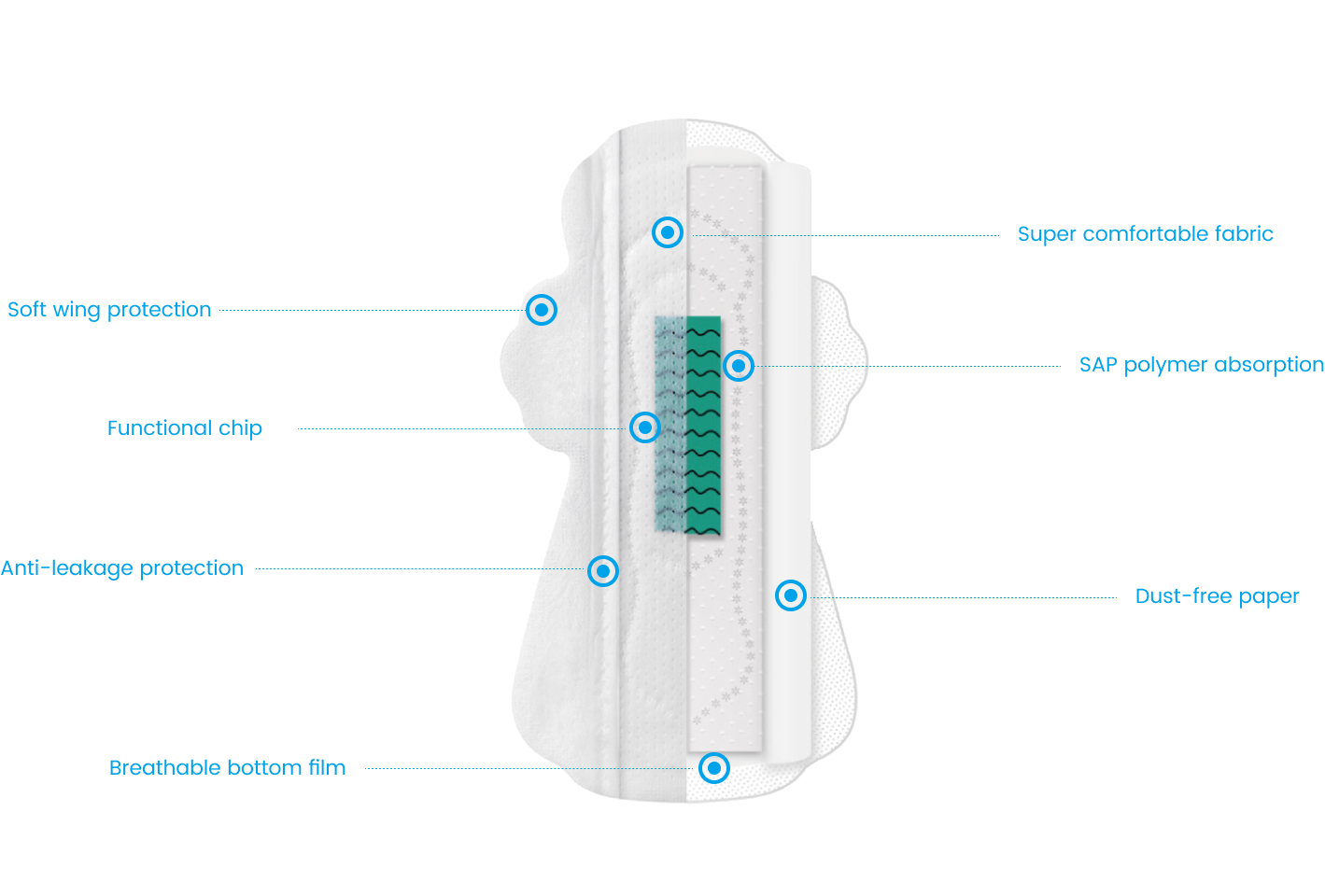
I distinguish finished-pad rewet testing from component-level testing because each answers a different development question. A finished-pad test evaluates the interaction of the topsheet, acquisition layer, absorbent core, tissue, backsheet, embossing, adhesive pattern, and compression profile. This is the most relevant test when approving a commercial sanitary pad.
Absorbent-core testing isolates the core material or core assembly. It can help compare SAP concentration, fluff pulp distribution, air-laid structure, or core density, but it does not fully predict the finished product because the topsheet and acquisition layer affect fluid entry and return.
Topsheet testing focuses on liquid passage, surface wetness, and contact behavior. Rewet-under-load testing adds compression to the evaluation and is especially useful for overnight pads, heavy-flow products, maternity pads, and products designed for active movement. I recommend labeling every result by test level so that a component result is not mistakenly presented as finished-pad performance.
Lower rewet is generally preferable when the goal is a dry-feeling sanitary pad. However, I do not recommend setting one universal acceptance value for every product because product size, flow category, material structure, dose volume, test liquid, and target market can differ substantially.
A practical acceptance system can classify products by intended use:
| Product tier | Main design priority | Suggested evaluation approach |
|---|---|---|
| Pantyliner or light-use pad | Surface dryness at low dose | Use a lower fluid dose and emphasize topsheet rewet |
| Regular daytime pad | Balanced dryness and capacity | Combine rewet with strike-through and moderate-load retention |
| Heavy-flow or overnight pad | Retention under compression | Use a higher dose and assess rewet after defined load exposure |
| Maternity or specialized pad | High fluid challenge and leakage control | Pair rewet with edge leakage and repeated-dose testing |
| Premium or sensitive-skin range | Consistent dry contact surface | Track average, variation, and batch-to-batch stability |
I also compare the average with the individual range. A low average accompanied by one unusually high result may indicate local core variation, uneven SAP distribution, inconsistent embossing, or dosing misalignment. For production control, the laboratory should establish an approved reference range from multiple qualified batches rather than choosing an arbitrary value from one test.
The most common problem is comparing results produced under different test conditions. A result based on saline cannot be directly ranked against one based on synthetic menstrual fluid without considering viscosity and fluid composition. Differences in dose volume, pressure, load area, waiting time, filter paper, and weighing delay can also change the outcome.
Sample positioning creates another source of error. Testing the center of one pad and the front or rear zone of another may produce different results because absorbent materials are often distributed unevenly by design. I mark the dosing and measurement location before testing and use the same orientation for every replicate.
Operator handling also matters. Pressing the filter paper onto the topsheet, moving the pad during loading, or delaying the wet-paper weighing step can alter the measured mass. I use written work instructions, calibrated balances, fixed load equipment, and a controlled data sheet to reduce these effects.
When selecting rewet testing equipment for sanitary pads, I focus on control and repeatability rather than the number of features listed by a supplier. The equipment should provide a stable loading surface, defined pressure or force, repeatable dwell time, accurate balance readings, and enough space for different pad sizes. A basic laboratory setup may be suitable for early development, while a production laboratory may require a dedicated rewet tester with controlled loading and digital records.
Useful equipment-selection criteria include:
For small manufacturers, a calibrated balance, fixed weights, a defined filter-paper specification, and a written procedure may be sufficient for screening. For larger laboratories, an instrumented tester can reduce operator variation and improve traceability. In either case, equipment does not replace method control; an expensive machine can still produce weak data if the fluid, dosing, pressure, or sample location is inconsistent.
As a Sanitary Pad Contract Manufacturer, Bainuo can use rewet testing as one part of a broader OEM or ODM product approval process. Bainuo describes its manufacturing operation as integrating research and development, production, sales, laboratory testing, and customized sanitary pad development. Its product-development scope includes different pad sizes, absorbency levels, topsheet materials, absorbent-core structures, and packaging formats.
For an OEM buyer, I would connect the rewet report to the approved sample rather than reviewing the value in isolation. The approval file should include the product specification, raw-material configuration, test liquid, dosing volume, pressure condition, rewet results, absorbency results, and photographs or sample references. When production changes from the approved configuration, the same test should be repeated before release.
This approach is useful for private-label brands, distributors, retail chains, and e-commerce sellers because consumer-facing claims about dryness need technical support. A manufacturer such as Bainuo can help coordinate product customization, sample development, laboratory checks, and repeat production, but the buyer should still define the required test conditions and acceptance criteria in writing.
A clear report should allow another technician to reproduce the test without asking for missing details. I use the following structure when preparing a sanitary pad performance record:
| Report field | Example entry |
|---|---|
| Product name and code | Regular Day Pad, SKU RP-01 |
| Sample lot | Lot 2026-08-A |
| Test date | September 21, 2026 |
| Test liquid | Defined synthetic menstrual fluid |
| Dose volume | Recorded in milliliters |
| Dosing location | Central absorbent zone |
| Absorption waiting time | Recorded in minutes |
| Filter paper | Type, dimensions, and dry mass |
| Applied load | Force, contact area, and pressure |
| Dwell time | Recorded in seconds or minutes |
| Individual rewet values | Each replicate listed separately |
| Mean rewet | Calculated in grams |
| Range and deviation | Minimum, maximum, and variation |
| Acceptance decision | Pass, conditional review, or fail |
| Operator and equipment ID | Recorded for traceability |
I recommend adding comments for unusual observations such as visible pooling, edge migration, surface tearing, core shifting, or delayed strike-through. These notes can explain why two products with similar rewet masses may perform differently during use. They also help production teams identify whether a result reflects material performance or a testing error.
What Is Rewet in Sanitary Pad Testing? It is the measured quantity of liquid that returns to the pad surface after absorption and controlled pressure. The test uses a defined liquid dose, a fixed waiting period, pre-weighed filter paper, controlled pressure, a set dwell time, and a final mass calculation. Lower rewet generally indicates a drier contact surface, but the result must be interpreted alongside absorption, strike-through, retention, leakage, and product structure.
I recommend establishing separate rewet criteria for liners, daytime pads, overnight products, heavy-flow pads, and specialized products. Manufacturers and OEM buyers should also distinguish finished-pad testing from topsheet, absorbent-core, and rewet-under-load evaluations. With a controlled method, transparent reporting template, and repeatable acceptance range, rewet data becomes useful for product development, supplier approval, production quality control, and substantiated dryness claims.
Latest News

Nov. 19, 2026
Nov. 18, 2026
Nov. 17, 2026
Talk to our experts today.
Tel: 0086 13302562673
Email: jennybainuo01@gmail.com
Add:No. 2 Building, No. 13 Tongsheng 1st Road, Nanshan Town, Sanshui District, Foshan City, Guangdong Province, 528100, China
NAVIGATION
NAVIGATION
CONTACT US
Tel: 0086 13302562673
Email: jennybainuo01@gmail.com
Add: No. 2 Building, No. 13 Tongsheng 1st Road, Nanshan Town, Sanshui District, Foshan, Guangdong, 528100,CHINA