Nov. 04, 2026
When I see “100% cotton” on sanitary pad packaging, I do not assume that the entire disposable pad is made from cotton. In most cases, the statement refers to a specific component, commonly the skin-contact topsheet, unless the package clearly identifies every layer as cotton. The absorbent core, leak-proof backsheet, adhesive, release paper, dyes, and other materials may still be made from different fibers or polymers.
This distinction matters because a sanitary pad is a layered product rather than a single sheet of fabric. A cotton topsheet can affect softness and skin contact, but it does not automatically prove that the pad is plastic-free, biodegradable, fragrance-free, chlorine-free, or suitable for every person with sensitive skin. I recommend reading the full material disclosure instead of relying on one prominent front-of-pack claim.
!
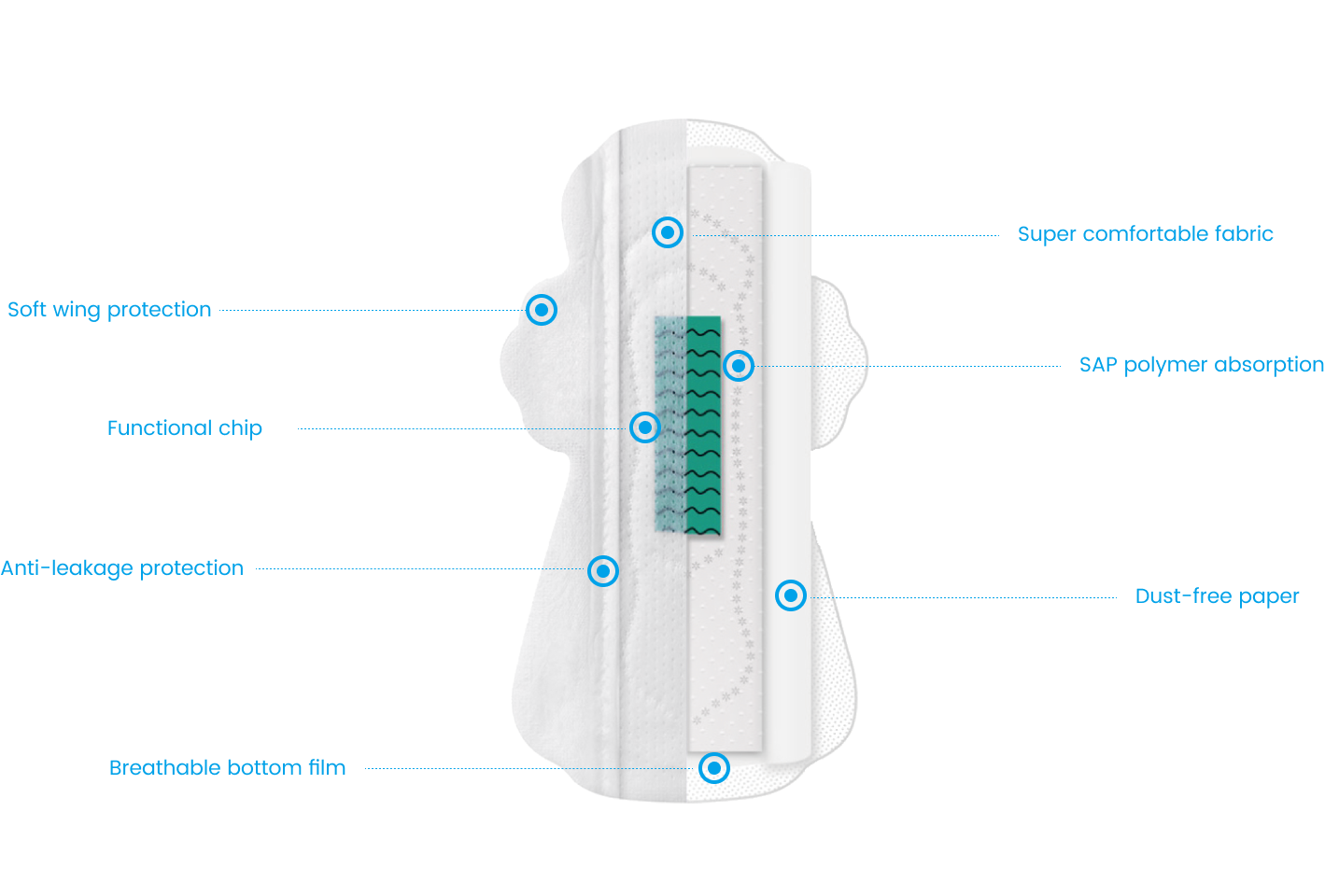
A sanitary pad normally contains several functional layers. The topsheet touches the body and allows menstrual fluid to pass downward, the absorbent core holds liquid, and the backsheet helps prevent leakage onto underwear. Additional components may include transfer layers, adhesives, elastic materials, packaging films, release paper, and printed designs.
The phrase “100% cotton” should therefore be read together with the noun that follows it. “100% cotton topsheet” is a more precise statement than simply “100% cotton pad.” If the package does not identify the layer, I look for a detailed materials list, product specification sheet, or manufacturer declaration before assuming that the entire pad is cotton.
No. 100% cotton generally means that the named component contains cotton as the stated fiber composition, not that every part of the pad is made from cotton. The pad may still include superabsorbent polymers, wood pulp, nonwoven transfer layers, polyethylene or polypropylene films, hot-melt adhesives, and silicone-coated release paper.
A complete cotton construction would need to be described separately for the topsheet, absorbent core, backsheet, and other components. Even then, the adhesive and packaging may remain non-cotton materials. I treat an unqualified “100% cotton” claim as incomplete until the manufacturer explains which layer it covers.
Understanding sanitary pad materials explained layer by layer makes product labels easier to evaluate. The topsheet may be made from cotton, rayon, polypropylene, polyethylene, or a blend designed to move fluid toward the absorbent core. The transfer layer can use nonwoven fibers, while the core may combine cellulose pulp and superabsorbent polymers to hold liquid.
Cotton is a natural cellulosic fiber with a soft hand feel, but it is not automatically the most absorbent or fastest-drying option in every pad design. Rayon is also cellulose-based but is manufactured from regenerated cellulose, and its behavior depends on fiber structure and processing. Plastics are commonly used in backsheets and packaging because they provide liquid resistance and structural stability.
| Pad component | Common materials | Main function |
|---|---|---|
| Topsheet | Cotton, rayon, polypropylene, polyethylene, blends | Skin contact and fluid entry |
| Transfer layer | Nonwoven fibers, cellulose-based fibers, synthetic fibers | Moves fluid toward the core |
| Absorbent core | Wood pulp, cotton, rayon, superabsorbent polymer | Stores menstrual fluid |
| Backsheet | Polyethylene, polypropylene, breathable composite film | Reduces leakage |
| Adhesive system | Hot-melt adhesive, pressure-sensitive adhesive | Holds layers together |
| Release paper | Coated paper or film | Protects the adhesive before use |
| Packaging | Paper, plastic film, composite materials | Individual and external protection |
A pad’s performance depends on how these layers work together. A cotton topsheet may feel soft, but leakage protection also requires adequate core capacity, fluid distribution, edge sealing, wing adhesion, and a backsheet that resists liquid under movement. For that reason, I compare the whole construction rather than judging performance from the topsheet alone.
A cotton-surface pad works through a sequence of fluid-transfer steps. Menstrual fluid first contacts the topsheet, passes through openings or spaces in the surface layer, moves through a transfer layer, and enters the absorbent core. The core then retains liquid, while the backsheet limits downward leakage.
Cotton can provide a familiar, fabric-like contact surface, but its performance varies with fiber length, web structure, thickness, finishing, and compression. If the topsheet holds too much moisture at the surface, the user may experience a damp sensation or rewet when pressure is applied. If the transfer layer and core are well matched, fluid can move away from the skin more efficiently.
For heavy flow or overnight use, I focus on more than the cotton claim. I check the pad’s length, width, wing design, core distribution, side barriers, and stated absorbency information. A soft surface is useful, but it cannot compensate for insufficient core capacity or poor leakage control.
People looking for 100% cotton sanitary pads for sensitive skin often want to reduce exposure to synthetic surface materials, fragrance, or dyes. A cotton topsheet may feel more comfortable for some users, particularly when friction or surface texture contributes to irritation. However, cotton labeling alone does not guarantee medical safety or prevent every skin reaction.
Irritation can result from several factors, including moisture, friction, heat, adhesive contact, fragrances, preservatives, dyes, detergent residues, or individual allergies. A pad labeled hypoallergenic may have been designed to reduce common irritants, but that term does not prove that the product will suit every person. I give greater weight to a complete ingredient and materials disclosure than to a single comfort claim.
For sensitive skin, I usually prioritize:
If burning, persistent itching, rash, swelling, or pain occurs, I stop using the product and seek medical advice. A change in pad material may help identify a trigger, but “100% cotton” should not be treated as a medical guarantee.
The difference between 100% cotton vs organic cotton sanitary pads mainly concerns cotton sourcing and production standards. “100% cotton” describes fiber composition for the named component, while “organic cotton” generally describes how the cotton was grown and handled under a defined certification system. Organic cotton can still be used in only the topsheet rather than the complete pad.
An organic cotton topsheet does not automatically mean the absorbent core, backsheet, adhesives, or packaging are organic or biodegradable. Conversely, a conventional cotton topsheet may still be free from fragrance and suitable for a user who is primarily concerned about skin contact. I compare the exact certification scope rather than assuming that the word “organic” applies to the entire product.
| Claim | What it may establish | What it does not automatically establish |
|---|---|---|
| 100% cotton | The named layer uses cotton as the stated fiber | That the entire pad is cotton or plastic-free |
| Organic cotton | Cotton was produced under a recognized organic standard | That every layer is organic or biodegradable |
| Cotton-like | The surface resembles cotton in feel or appearance | That the surface contains cotton |
| Hypoallergenic | The product is marketed or tested for reduced allergen concerns | That no user can react to it |
| Chlorine-free | A stated bleaching process or material avoids chlorine under the claim’s scope | That the entire pad contains no processing chemicals |
| Biodegradable | One or more components may break down under specified conditions | That the whole pad disappears in ordinary landfill disposal |
| Fragrance-free | No added fragrance is declared | That the product contains no odor-control or processing additives |
Cotton and rayon are often selected for their soft, absorbent, or cellulose-based characteristics, but they are not interchangeable. Rayon can be engineered into fibers that move liquid efficiently, while cotton may provide a more natural textile feel. The actual result depends on basis weight, fiber arrangement, layer thickness, and how the material is combined with the core.
Superabsorbent polymers are commonly used inside the absorbent core because they can retain large amounts of fluid relative to their dry mass. Their presence does not mean the topsheet is synthetic, and their absence does not prove that a pad is safer or more comfortable. A pad using mostly cotton may still need a separate core material to provide adequate capacity for moderate or heavy flow.
Plastic components also have specific functions. A polyethylene or polypropylene backsheet can reduce leakage, support a breathable-film design, and protect underwear during sitting or movement. The trade-off is that a disposable pad with a plastic backsheet is not accurately described as completely plastic-free, even when its surface layer is cotton.
Environmental claims require careful wording because a pad can contain natural fibers and still generate persistent waste. Cotton, rayon, and wood pulp are cellulose-based materials, but the presence of synthetic backsheet film, superabsorbent polymers, adhesives, packaging, and contamination can affect disposal. A biodegradable component does not make the entire used pad suitable for home composting or normal recycling.
Bleaching claims also need context. “Chlorine-free” may refer to a particular pulp, cotton treatment, or bleaching method, so I check whether the wording applies to the whole product or one raw material. Likewise, “biodegradable” should be connected to a stated testing environment, time period, and percentage of the product covered by the claim.
I dispose of used sanitary pads according to local household-waste rules rather than flushing them or placing them in recycling bins. Product packaging should explain disposal when special systems are required. From an environmental perspective, the most reliable comparison is a complete material inventory paired with clear disposal instructions, not a single green label.
A genuine cotton claim should identify the relevant layer and provide enough information for comparison. I look for terms such as “cotton topsheet,” “organic cotton surface,” or a fiber composition statement rather than relying on illustrations of cotton flowers. A “cotton-like” description may indicate a synthetic nonwoven material designed to resemble cotton in softness.
For private-label buyers and distributors, supplier documentation is especially important. A manufacturer should be able to explain the topsheet composition, core materials, backsheet film, adhesive system, fragrance status, packaging structure, and applicable certifications. Bainuo, a 100% Cotton Sanitary Pads Manufacturer, operates as Guangdong Bainuo Sanitary Product Co., Ltd., a sanitary-product manufacturer established in 2006 with R&D, production, sales, OEM, and ODM capabilities.
Bainuo’s product scope includes sanitary napkins, menstrual pants, organic cotton sanitary pads, biodegradable sanitary pads, bamboo-fiber products, and customized packaging. Its manufacturing information also identifies production lines, raw-material handling, laboratory testing, automatic packaging, and final-shipment procedures. For a buyer evaluating a cotton pad, I would still request the product-specific specification sheet and test documentation rather than assuming that a company-wide product category applies to every model.
I use a practical decision process instead of choosing only by the front label. First, I identify whether the claim applies to the topsheet, the core, or the full product. Next, I check whether the core matches my expected flow level and whether the backsheet, wings, and side barriers provide enough protection for movement or overnight use.
| If your priority is… | Check first | Why it matters |
|---|---|---|
| Sensitive skin | Fragrance-free, dye-free, smooth topsheet, adhesive information | Reduces exposure to commonly reported irritants |
| Heavy flow | Core structure, length, width, side barriers, stated capacity | Cotton alone does not determine absorbency |
| Overnight use | Extended length, rear coverage, wings, leakage barriers | Body position changes during sleep |
| Lower plastic use | Backsheet and packaging composition | A cotton topsheet does not prove plastic-free construction |
| Organic sourcing | Certification name and scope | Confirms whether organic applies to cotton or the whole pad |
| No chlorine claim | Exact material and processing covered | Prevents overinterpreting a partial claim |
| Teen users | Fit, thickness, fragrance status, easy-to-read labeling | Comfort and simple product selection are practical concerns |
| Private-label sourcing | Specification sheets, testing, factory capability, MOQ, packaging options | Supports consistent product and compliance decisions |
Price should also be considered over the full period of use. A thinner premium pad may require more frequent changes, while a higher-capacity design may reduce the number used during a day, but these outcomes depend on individual flow and product fit. I compare cost per pad, expected change frequency, packaging quantity, and performance needs rather than cost per package alone.
What Does “100% Cotton” Mean in Sanitary Pads? It usually means that a specified component, most often the topsheet, is made from cotton according to the stated composition. It does not automatically mean that the entire disposable pad is cotton, plastic-free, biodegradable, chlorine-free, fragrance-free, or medically safer for every user.
My next step would be to read the product’s full materials disclosure and separate the topsheet, transfer layer, absorbent core, backsheet, adhesives, additives, and packaging. I would then match the construction to my flow level, skin sensitivity, leakage concerns, environmental priorities, and budget. For buyers assessing a supplier such as Bainuo, I would request product-specific composition details, certification scope, laboratory reports, and sample testing before approving a private-label or bulk order.
Latest News
Nov. 11, 2026
Nov. 10, 2026
Nov. 09, 2026
Talk to our experts today.
Tel: 0086 13302562673
Email: jennybainuo01@gmail.com
Add:No. 2 Building, No. 13 Tongsheng 1st Road, Nanshan Town, Sanshui District, Foshan City, Guangdong Province, 528100, China
NAVIGATION
NAVIGATION
CONTACT US
Tel: 0086 13302562673
Email: jennybainuo01@gmail.com
Add: No. 2 Building, No. 13 Tongsheng 1st Road, Nanshan Town, Sanshui District, Foshan, Guangdong, 528100,CHINA