Nov. 09, 2026
A breathable backsheet is a liquid-resistant, vapor-permeable layer that uses micropores or a permeable laminate to let heat and water vapor escape while stopping menstrual fluid from reaching clothing. In a sanitary pad, it sits beneath the absorbent core and works with the topsheet, acquisition layer, absorbent core, and adhesive system to balance ventilation, dryness, comfort, and leakage protection.
When I explain breathable sanitary pad technology, I describe the backsheet as a controlled barrier rather than simply a sheet with holes. Its pores are engineered to be small enough to restrict liquid passage while allowing water vapor and some air movement. This difference allows moisture generated by body heat and perspiration to move away from the skin-facing side of the pad.
A conventional plastic backsheet mainly focuses on stopping liquid from passing through. A breathable backsheet adds vapor transmission to that function, which can reduce the enclosed, humid feeling that some users experience during extended wear. However, breathability does not mean the pad is completely open to air, and it does not guarantee zero leakage under every wearing condition.
The backsheet must also remain attached to the absorbent structure during bending, compression, movement, and packaging. For that reason, manufacturers evaluate more than moisture vapor transmission rate for sanitary pads. They also examine tensile strength, puncture resistance, adhesive bonding, seam integrity, compression recovery, and liquid barrier performance.
I understand the mechanism as a sequence of material and structural functions:
Many breathable films use a polyethylene-based polymer combined with mineral filler particles, often calcium carbonate. During film formation, the filler is dispersed inside the polymer matrix. Controlled stretching then creates microscopic pathways around the particles without converting the entire sheet into an unrestricted mesh.
The resulting pores are not large openings that allow menstrual fluid to flow freely. Their function depends on pore size, pore distribution, surface energy, film thickness, liquid pressure, and the interaction between the backsheet and the absorbent core. If the film is overstretched, damaged, folded sharply, or exposed to excessive pressure, its barrier performance can change.
A laminate may combine the breathable film with a nonwoven layer. The film provides liquid resistance and vapor transmission, while the nonwoven can improve softness, handling, printability, and resistance to tearing. The final material therefore behaves differently from the film alone because bonding, embossing, adhesive coverage, and mechanical tension affect the finished backsheet.
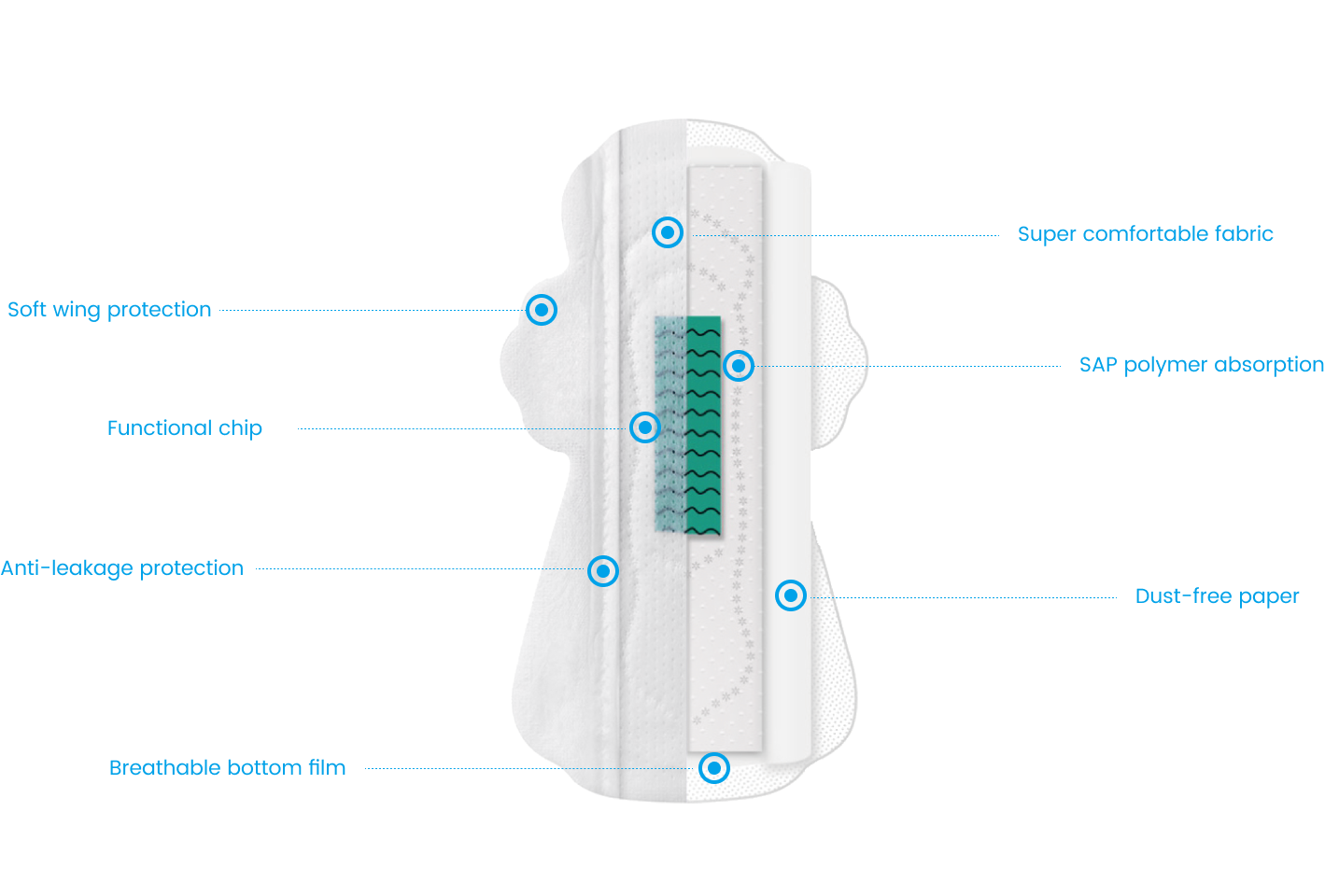
A breathable backsheet cannot be evaluated separately from the whole sanitary pad. The pad normally contains several functional layers, and each layer influences how moisture and liquid move through the product.
| Pad layer | Main function | Relationship with the backsheet |
|---|---|---|
| Topsheet | Receives menstrual fluid and contacts the skin | Controls how quickly liquid leaves the surface |
| Acquisition layer | Spreads fluid and reduces surface pooling | Helps prevent localized pressure against the backsheet |
| Absorbent core | Stores liquid using cellulose, superabsorbent polymer, or both | Determines how much liquid reaches the lower layers |
| Backsheet | Blocks liquid and permits controlled vapor transmission | Provides the primary clothing-side barrier |
| Adhesive system | Holds the pad and wings in position | Can reduce breathability if coverage is excessive |
| Release paper | Protects adhesive before use | Does not contribute to breathability during wear |
The topsheet is usually a hydrophilic or treated nonwoven designed to receive fluid quickly. Beneath it, the acquisition layer distributes liquid across a wider area, reducing the chance that one small region of the absorbent core becomes saturated. This distribution matters because concentrated wetness can increase pressure on the backsheet during sitting, sleeping, or physical activity.
The absorbent core stores the largest portion of menstrual fluid. If the core is too thin, poorly distributed, or compressed during use, liquid may remain near the bottom of the structure. In that situation, the backsheet experiences greater wetting pressure, and a breathable film may perform differently from its laboratory result.
The adhesive system also affects the outcome. Full-surface adhesive coverage can improve bonding between layers, but it may reduce the effective area available for vapor transmission. Manufacturers therefore balance adhesive pattern, coat weight, bonding strength, and peel resistance instead of assuming that more adhesive automatically improves pad integrity.
!
The main breathable sanitary pad materials include microporous polyethylene film, breathable nonwoven laminates, elastomer-modified films, and adhesive layers designed for hygienic product assembly. Polyethylene is widely used because it can be processed into thin films and combined with mineral fillers to create controlled microporosity.
A nonwoven backsheet may be made from spunbond or other fiber-based structures. Nonwovens can provide a textile-like feel, but a nonwoven by itself may not provide the liquid barrier required for a menstrual pad. For that reason, many designs use a film and nonwoven laminate rather than relying on a single fiber layer.
Material selection usually depends on five factors:
A thin film may provide greater vapor transmission per unit area, but reducing thickness can also reduce puncture resistance and handling strength. A thicker film may improve mechanical durability while lowering vapor transmission and increasing material usage. This is why a backsheet specification should define a performance range rather than relying only on the word “breathable.”
The difference between a breathable backsheet and a traditional waterproof backsheet is mainly the movement of vapor, not whether the product can resist liquid. Both designs are intended to keep menstrual fluid away from clothing, but they use different material structures and may produce different comfort characteristics.
| Factor | Breathable backsheet | Conventional waterproof backsheet |
|---|---|---|
| Main barrier | Liquid-resistant microporous film or laminate | Continuous low-permeability plastic film |
| Water vapor movement | Controlled transmission through micropores or permeable structure | Limited, depending on film formulation |
| Heat and humidity management | May reduce moisture accumulation around the pad | Can retain more heat and vapor inside the pad |
| Mechanical design | Requires careful control of stretching, bonding, and handling | Often simpler film construction |
| Leakage protection | Depends on pore structure, core design, and finished-pad testing | Depends mainly on continuous film integrity |
| Main trade-off | Breathability may compete with strength and bonding | Lower vapor transmission but potentially simpler processing |
A breathable pad is not automatically better in every situation. If the absorbent core saturates, if the pad shifts, or if the wings do not bond correctly to underwear, a breathable backsheet cannot compensate for the design problem. I therefore treat breathability as one part of performance rather than a complete measure of product quality.
During wear, the area between the body, pad, and underwear can become warmer and more humid than the surrounding environment. Perspiration, body heat, menstrual fluid, and limited air circulation all contribute to this condition. A vapor-permeable backsheet can help water vapor move toward the clothing side, although the actual result depends on temperature, humidity, underwear fabric, clothing pressure, and wearing time.
The benefit is usually related to moisture management, not direct cooling. A pad does not function like an air-conditioning system, and air permeability may be limited by the absorbent core and underwear. Nevertheless, reducing vapor accumulation can improve the perceived dryness of the product for some users, especially in hot climates or during extended daytime wear.
Skin comfort also depends on the topsheet, edge design, fragrance additives, adhesive residues, surface friction, and changing frequency. A breathable backsheet may reduce one source of discomfort while other materials create another. For sensitive-skin product development, I recommend evaluating the complete contact system instead of selecting a backsheet based on vapor transmission alone.
A material-level test normally measures one property under controlled conditions. A finished-pad test examines the assembled product, where the backsheet interacts with the core, adhesive, embossing, wrappers, and compression.
The moisture vapor transmission rate for sanitary pads indicates how much water vapor passes through a defined area over a specified time under controlled temperature and humidity conditions. Common laboratory methods use a cup or chamber arrangement, but the selected method, test direction, humidity gradient, specimen conditioning, and exposed area must be stated clearly.
A higher laboratory MVTR does not automatically mean a more comfortable sanitary pad. If adhesive covers most of the backsheet, if the absorbent core holds vapor, or if underwear blocks the outer surface, the finished product may transmit less vapor than the isolated film.
Liquid barrier testing evaluates whether fluid passes through the backsheet under controlled contact or pressure. Hydrostatic resistance can indicate the pressure required for liquid to penetrate the material. These measurements are useful, but they should be paired with finished-pad leakage tests because the pad’s edges, seams, wings, and compression points can become failure locations.
Tensile strength measures resistance to pulling in the machine and cross-machine directions. Tear and puncture tests help show whether the backsheet can survive folding, cutting, converting, and consumer handling. A film that performs well for vapor transmission but tears during high-speed production may not be suitable for commercial sanitary pad manufacturing.
A finished sanitary pad should be assessed for absorption capacity, rewet, leakage resistance, peel strength, bending behavior, compression recovery, and dimensional stability. I also recommend testing after packaging and simulated storage because pressure from cartons or individual wrappers can alter the backsheet structure.
| Test area | What it helps verify | Why the result matters |
|---|---|---|
| MVTR | Vapor transmission through the specimen | Indicates potential ventilation |
| Liquid penetration | Resistance to fluid passage | Supports leakage prevention |
| Tensile and tear | Mechanical durability | Reduces production and use-related damage |
| Adhesive peel | Bonding between layers or pad and underwear | Helps maintain positioning and structure |
| Compression recovery | Behavior after pressure | Relevant to sitting, sleeping, and packaging |
| Rewet | Liquid return toward the topsheet | Relates to surface dryness and comfort |
| Finished-pad leakage | Overall system protection | Confirms real product performance |
The breathable backsheet manufacturing process must control filler dispersion, film thickness, stretching ratio, winding tension, laminate bonding, and converting speed. Inconsistent stretching can produce uneven pore formation, while excessive stretching may reduce tensile strength. Insufficient stretching may produce a film with lower vapor transmission than the specification requires.
Embossing creates channels, shape definition, and visual structure, but deep embossing can concentrate stress in the film. It may also create thin points that become vulnerable during folding or compression. The embossing pattern must therefore be considered alongside film thickness, core density, and production-line tension.
Adhesive bonding creates another balance. Too little adhesive can cause delamination, edge lifting, or shifting between layers. Too much adhesive can reduce the effective breathable area, increase stiffness, and contribute to odor or noise concerns. A suitable design specifies adhesive location and coat weight rather than applying adhesive uniformly without performance testing.
For brands evaluating a breathable sanitary pad supplier comparison, I recommend requesting the film construction, nominal thickness, MVTR test method, liquid resistance method, tensile data, laminate structure, adhesive pattern, and finished-pad test results. Supplier claims should be compared only when the test conditions are equivalent.
Bainuo operates as a Sanitary Napkin OEM Manufacturer serving sanitary napkin, pantyliner, menstrual pants, and private-label product programs. The company states that Guangdong Bainuo Sanitary Product Co., Ltd. was established in 2006 and combines research and development, production, sales, laboratory testing, automated packaging, and OEM/ODM support. Its published manufacturing information also identifies raw-material preparation, production-line processing, automatic packaging, laboratory testing, and final shipment as parts of its workflow.
When I assess a supplier for breathable backsheet products, I look for the ability to connect material selection with finished-pad validation. Bainuo’s product and production information includes sanitary napkin lines, packaging equipment, a laboratory, and document-support services, which are relevant when a buyer needs more than an isolated breathable film. The buyer should still request project-specific specifications and test reports before approving a production order.
A practical OEM discussion should cover pad length, wing structure, core composition, topsheet type, backsheet laminate, adhesive pattern, embossing, packaging format, minimum order quantity, sampling procedure, and inspection plan. The supplier should also clarify whether test values apply to raw film, laminate, or the finished sanitary pad. This distinction prevents material-level performance from being presented as a finished-product guarantee.
I recommend using the following checklist when comparing breathable sanitary pads or developing a private-label product:
For consumers, a breathable backsheet may be useful when heat and humidity are major comfort concerns, but changing frequency, pad fit, absorbent capacity, and personal skin response remain important. For manufacturers, the correct choice depends on the intended use case, target leakage protection, material budget, production equipment, and required certification or compliance documentation.
How Do Breathable Backsheets Work in Sanitary Pads? They use microporous films or permeable laminates to create controlled pathways for water vapor while maintaining resistance to menstrual fluid. Filler particles, stretching, film structure, adhesive coverage, embossing, and the absorbent core all influence whether the finished pad actually delivers the intended balance of ventilation and leakage protection.
I do not recommend judging a breathable backsheet by MVTR alone. The more reliable approach is to evaluate the complete sanitary-pad structure through vapor transmission, liquid barrier, tensile, tear, bonding, compression, rewet, and finished-pad leakage tests. Consumers can use these principles to compare comfort and protection claims, while brands can use them to brief an OEM partner such as Bainuo with measurable specifications rather than general marketing language.
Latest News
Nov. 11, 2026
Nov. 10, 2026
Nov. 09, 2026
Talk to our experts today.
Tel: 0086 13302562673
Email: jennybainuo01@gmail.com
Add:No. 2 Building, No. 13 Tongsheng 1st Road, Nanshan Town, Sanshui District, Foshan City, Guangdong Province, 528100, China
NAVIGATION
NAVIGATION
CONTACT US
Tel: 0086 13302562673
Email: jennybainuo01@gmail.com
Add: No. 2 Building, No. 13 Tongsheng 1st Road, Nanshan Town, Sanshui District, Foshan, Guangdong, 528100,CHINA