Nov. 17, 2026
When I compare sanitary pads, I treat Absorption Speed vs Capacity in Sanitary Pads as two separate performance measurements. Absorption speed describes how quickly menstrual fluid moves away from the surface and into the absorbent core, while capacity describes how much fluid the pad can retain before saturation or leakage. A high-capacity pad is not automatically fast-absorbing, so both measurements matter for practical leak protection.
For buyers, the distinction affects comfort, dryness, changing frequency, and protection during different stages of menstrual flow. A pad that absorbs quickly can reduce surface wetness during a sudden release, but it may not hold enough fluid for several hours. A pad with a large absorbent core may retain more liquid overall, yet still allow temporary pooling or rewet if fluid spreads slowly through the structure.
I use this guide to explain how sanitary pad absorption works, how to compare products with a simple test method, and how to choose between fast absorption and high capacity. I also include the construction factors that influence performance, including the top sheet, acquisition and distribution layer, absorbent core, superabsorbent polymer, and backsheet.
Absorption speed is the time required for fluid to move from the pad’s top surface into the absorbent structure. In practical use, faster absorption can reduce visible wetness, surface pooling, and the chance that fluid reaches the edge before entering the core. It is especially important when menstrual fluid is released quickly or unevenly.
Absorption capacity is the total fluid volume that a sanitary pad can retain before leakage, saturation, or structural failure. Capacity depends on the amount and arrangement of fluff pulp, superabsorbent polymer, pad dimensions, core geometry, and the ability of the internal layers to distribute liquid. A longer or thicker pad often has greater capacity, but size alone does not guarantee effective protection.
These are separate performance variables. A pad may absorb the first release quickly but have limited working capacity, while another may hold a large volume but absorb slowly during a sudden flow event. I therefore evaluate speed and capacity together rather than treating an absorbency claim as a complete performance description.
Sanitary pad absorption speed describes how quickly liquid disappears from the surface after application. Testing usually measures the time between placing a defined amount of test fluid on the top sheet and observing when the surface is visibly free of standing liquid. A shorter time indicates faster acquisition under that specific test condition.
Speed matters because menstrual flow is not always gradual. A person may experience a sudden release after standing, sitting, exercising, or sleeping. If the pad’s top sheet and acquisition layer cannot move the fluid downward quickly enough, liquid may remain near the surface, spread laterally, or move toward the leg opening before the core retains it.
Fast absorption can improve surface dryness, but it does not automatically eliminate leakage. If the acquisition layer transfers fluid quickly but the core cannot distribute or retain it, the liquid may accumulate in one area. This can create localized saturation, rewet, or edge leakage even when the initial absorption time appears favorable.
Sanitary pad absorption capacity refers to the amount of fluid retained by the product before leakage occurs. A laboratory measurement may involve repeated fluid additions until the pad reaches saturation, but this total number does not always represent the amount a person can use comfortably during movement. For that reason, I distinguish between total saturation capacity and effective working capacity.
Total saturation capacity is the maximum volume retained under controlled conditions. Effective working capacity is the amount retained while the pad remains functional during pressure, body movement, compression, and repeated fluid release. Effective working capacity may be lower because pressure can force retained fluid back toward the surface or sides.
High capacity is more important for heavy menstrual flow, overnight use, and situations where changing opportunities are limited. However, the pad must also distribute fluid across the core instead of concentrating it in one small zone. A product with a large stated capacity can still leak early if its fluid channels, side barriers, or core geometry do not match the user’s flow pattern.
!
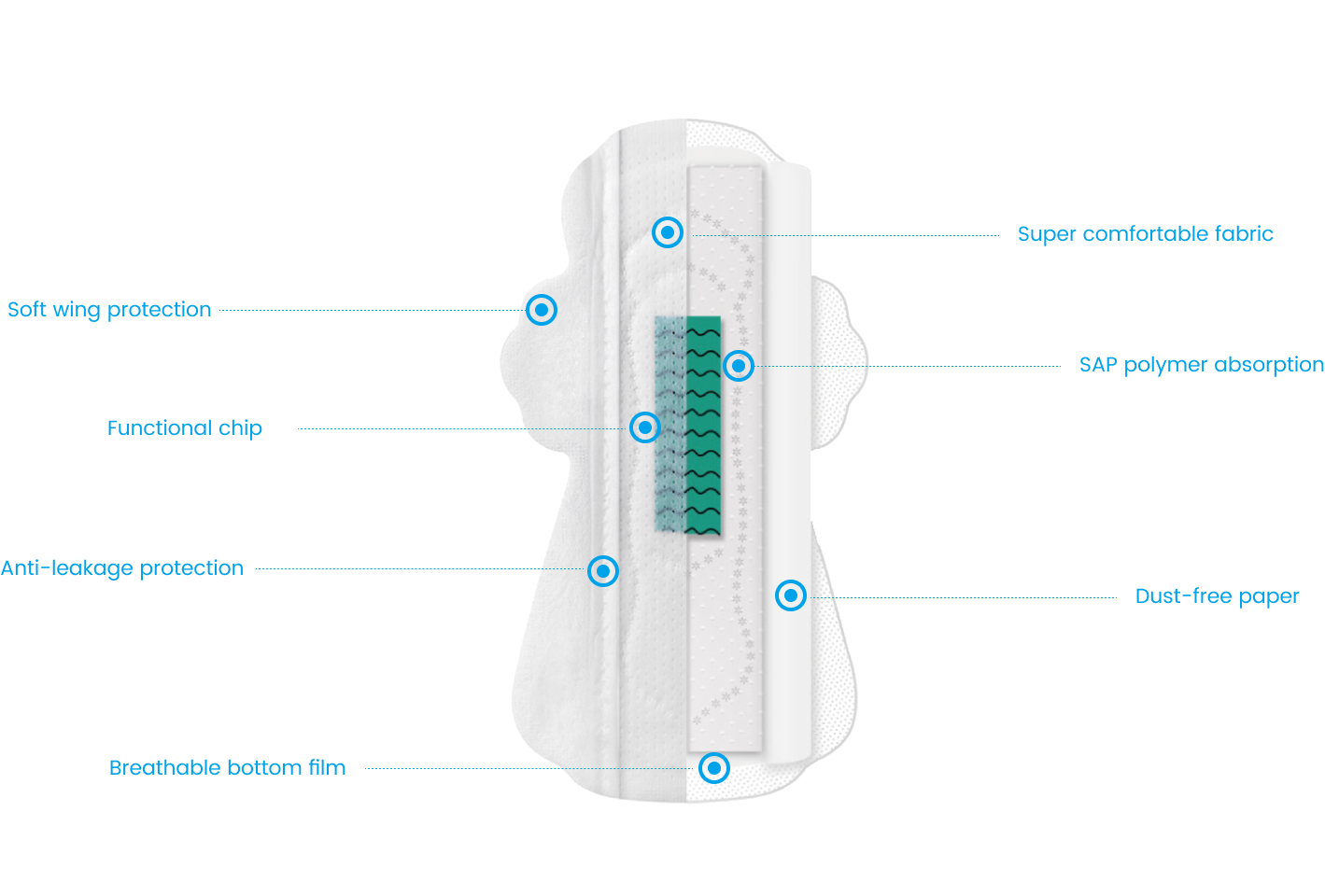
I evaluate the pad as a layered system rather than focusing on one material. Each layer has a different task, and a weakness in one layer can limit the performance of the entire product. The main structure normally includes the top sheet, acquisition and distribution layer, absorbent core, superabsorbent polymer, and backsheet.
The top sheet is the material that contacts the body and receives menstrual fluid first. Its surface design, pore structure, softness, hydrophilicity, and liquid-transfer characteristics influence how quickly fluid enters the pad. A top sheet that resists wetting can slow acquisition, while one that transfers fluid too aggressively without sufficient distribution may contribute to localized loading.
I also examine whether the top sheet supports low rewet after pressure is applied. Rewet occurs when fluid returns toward the surface after the pad has already absorbed it. This can affect comfort and skin dryness, particularly during sitting, walking, or sleeping.
The acquisition and distribution layer, often positioned beneath the top sheet, helps receive a rapid fluid release and spread it across a larger area. It can reduce surface pooling by moving liquid downward and outward before the core becomes overloaded in one location. Its thickness, fiber structure, density, and compression resistance influence both speed and repeated-flow performance.
A highly open layer may accept fluid quickly, but it must work with the absorbent core below it. If the core absorbs slowly, the acquisition layer can temporarily hold fluid and later release it under pressure. This is one reason why a fast initial absorption result does not always predict strong performance during movement.
The absorbent core provides the main fluid-retention function. It may contain cellulose fibers, fluff pulp, superabsorbent polymer, or combinations of these materials. The core’s basis weight, compression, shape, and channel design affect how fluid moves from the center to the front, rear, and side regions.
Core geometry is particularly important for overnight and heavy-flow products. A pad may contain enough material for high theoretical capacity but still leak near the back or sides if fluid cannot reach those areas efficiently. I therefore compare the core’s usable coverage with the body-facing dimensions of the product.
Superabsorbent polymer, commonly called SAP, absorbs and retains liquid within a gel structure. Its particle distribution, absorbency rate, swelling behavior, and resistance to pressure affect both speed and capacity. A larger SAP quantity may increase retention, but excessive swelling in one zone can restrict further liquid movement.
This creates a practical trade-off. A formulation optimized for rapid liquid uptake may not provide the same pressure retention as one optimized for maximum storage. The best balance depends on the intended use, such as daytime moderate flow, sudden heavy flow, overnight protection, or postpartum bleeding.
The backsheet helps prevent fluid from passing through the underside of the pad. It may include a breathable film, nonwoven layer, or composite construction. Side barriers, elastic elements, and wing design also influence whether fluid remains within the absorbent area during movement.
A backsheet cannot compensate for poor acquisition or an overloaded core. If liquid reaches the edge before entering the core, the barrier may only delay leakage. For this reason, I treat leak protection as the combined result of speed, distribution, capacity, fit, and product positioning.
Product labels often use broad terms such as “ultra absorbent” or “heavy flow protection.” Those descriptions do not explain the test volume, fluid viscosity, application rate, pressure, or endpoint. I recommend comparing identical pad samples under the same conditions rather than relying only on marketing language.
| Measurement | Simple test method | Useful result |
|---|---|---|
| Absorption speed | Apply a measured liquid volume to the center and record the time until surface pooling disappears | Lower time indicates faster acquisition |
| Distribution | Apply fluid at the center, front, and rear, then inspect wetting spread | More even wetting indicates better core utilization |
| Capacity | Add equal liquid portions until leakage or visible saturation occurs | Higher retained volume indicates greater total capacity |
| Rewet | Apply pressure with a measured weight after absorption, then inspect transferred liquid | Lower transfer indicates better pressure retention |
| Leakage | Apply repeated doses at timed intervals and inspect the edges and underside | Later leakage indicates stronger working protection |
| Repeated-flow performance | Use several doses rather than one large dose | Shows whether the pad continues working after partial loading |
For a basic comparison, I use the same liquid volume, application height, interval, temperature, and pressure for each sample. A meaningful test should include at least three identical pads per product because one sample cannot represent manufacturing variation. The results should be recorded in seconds, milliliters, or grams rather than described with unsupported terms.
The test should also distinguish a single large release from repeated smaller releases. Some pads perform well when fluid is added slowly but leak when a larger volume arrives in a short period. Others absorb the first application rapidly but show rewet after the core becomes partially loaded. These differences are important for people who experience sudden flow or sleep for several hours.
A sanitary pad can leak before reaching total saturation because fluid may not spread across the available absorbent area. Localized saturation can occur near the center, while the front, rear, or side sections remain relatively dry. In this situation, the product still contains unused capacity, but the liquid has reached a boundary or pressure point that allows leakage.
Fit and movement also affect the result. A pad may shift away from the correct position, causing fluid to miss the central acquisition zone. Sitting, bending, sleeping on one side, or exercising can place pressure on a loaded section and force liquid toward the edge.
This explains why total capacity is not the same as effective working capacity. When I compare pads, I inspect the leakage location, the wetting pattern, and the pressure response instead of recording only the final volume retained. A product that holds more liquid in a static test may not provide greater protection in real use if it distributes fluid unevenly.
The answer depends on the flow pattern and the time between changes. Fast absorption is usually more important when menstrual fluid arrives suddenly, when surface dryness is a priority, or when the user is active and needs quick acquisition. High capacity becomes more important during heavy flow, overnight use, travel, long work periods, or situations with limited access to changing facilities.
For light flow, I usually prioritize a thin pad with reliable acquisition and adequate retention rather than maximum capacity. For moderate flow, a balanced product with a fast top sheet, effective distribution layer, and medium-to-high core capacity is generally more practical. For heavy flow, I place greater weight on effective working capacity, back coverage, side barriers, and resistance to pressure-induced leakage.
| Use case | Greater priority | Additional feature to check |
|---|---|---|
| Light daytime flow | Absorption speed and surface dryness | Thin profile and low rewet |
| Sudden or uneven flow | Absorption speed and distribution | Large acquisition area |
| Heavy menstrual flow | Effective working capacity | Wide core, side barriers, and repeated-flow performance |
| Overnight use | Capacity and rear coverage | Longer back section and pressure resistance |
| Active movement | Balanced speed and capacity | Secure wings and flexible structure |
| Postpartum bleeding | Capacity, coverage, and leakage control | Larger size and frequent monitoring |
A higher-capacity pad does not necessarily absorb menstrual fluid faster. Capacity depends mainly on how much fluid the core can retain, while speed depends on how quickly fluid enters and spreads through the structure. Some designs provide both, but the claim should be confirmed through comparable testing.
I begin by estimating the timing and intensity of flow rather than choosing only by thickness. If the pad becomes wet on the surface soon after use, I look for improved absorption speed and a more effective acquisition layer. If leakage occurs after several hours even though the surface remains relatively dry, I focus on capacity, core coverage, and pressure retention.
For the best sanitary pads for heavy flow, I check five characteristics: effective working capacity, rear and side coverage, repeated-flow performance, low rewet under pressure, and secure positioning. A product intended for heavy flow should not depend only on a large amount of SAP. It should also distribute liquid across the full core and maintain protection when the user sits, walks, or sleeps.
I also compare the pad’s dimensions with the user’s body position and changing schedule. A shorter pad may be suitable for daytime use but inadequate overnight, while a long overnight product may feel unnecessarily bulky for light daytime flow. The correct choice is the one that matches fluid release, wear time, movement, and required coverage.
When I evaluate a Sanitary Pads Supplier, I look beyond product descriptions and ask how the supplier verifies raw materials, production consistency, and finished-pad performance. Bainuo, formally Guangdong Bainuo Sanitary Product Co., Ltd., was established in 2006 and operates in Foshan, Guangdong, China. The company describes its work as integrating research and development, production, sales, OEM, and ODM services for disposable sanitary products.
For a private-label buyer, the supplier’s process matters because absorption speed and capacity depend on controlled material combinations. Bainuo identifies production equipment such as sanitary napkin production lines, packaging machinery, robotic palletizing equipment, a laboratory, and an ethylene oxide sterilizer. Its published OEM and ODM process includes product planning, needs assessment, raw-material preparation, production, automatic packaging, laboratory testing, and final shipment.
I would still request product-specific evidence before approving a design. Useful documents include core-material specifications, SAP type and loading range, top-sheet and backsheet details, absorption-time results, capacity results, rewet data, leakage observations, and batch inspection records. A supplier’s general manufacturing capability is relevant, but each sanitary pad formulation should be judged by measured performance under defined conditions.
Absorption Speed vs Capacity in Sanitary Pads is not a choice between two identical forms of absorbency. Absorption speed measures how quickly fluid leaves the surface, while capacity measures how much fluid the pad can retain before leakage or saturation. For light flow, speed and surface dryness may matter most; for moderate flow, I recommend a balanced design; for heavy flow and overnight use, effective working capacity, distribution, coverage, and pressure resistance become more important.
My practical recommendation is to compare pads using the same test volume, repeated applications, timed absorption measurements, pressure-based rewet checks, and leakage observations. I would not select a product solely because it claims maximum absorbency or uses a larger core. I would evaluate how the top sheet, acquisition layer, absorbent core, SAP, backsheet, and side barriers work together.
For buyers and private-label brands, Bainuo can be considered as a Sanitary Pads Supplier with OEM and ODM production capabilities, but the final decision should rely on product-specific samples and quantitative test records. The best sanitary pad is the one that matches the user’s flow intensity, release pattern, wear duration, body movement, and required protection level.
Latest News

Nov. 19, 2026
Nov. 18, 2026
Nov. 17, 2026
Talk to our experts today.
Tel: 0086 13302562673
Email: jennybainuo01@gmail.com
Add:No. 2 Building, No. 13 Tongsheng 1st Road, Nanshan Town, Sanshui District, Foshan City, Guangdong Province, 528100, China
NAVIGATION
NAVIGATION
CONTACT US
Tel: 0086 13302562673
Email: jennybainuo01@gmail.com
Add: No. 2 Building, No. 13 Tongsheng 1st Road, Nanshan Town, Sanshui District, Foshan, Guangdong, 528100,CHINA